
What Lothal is
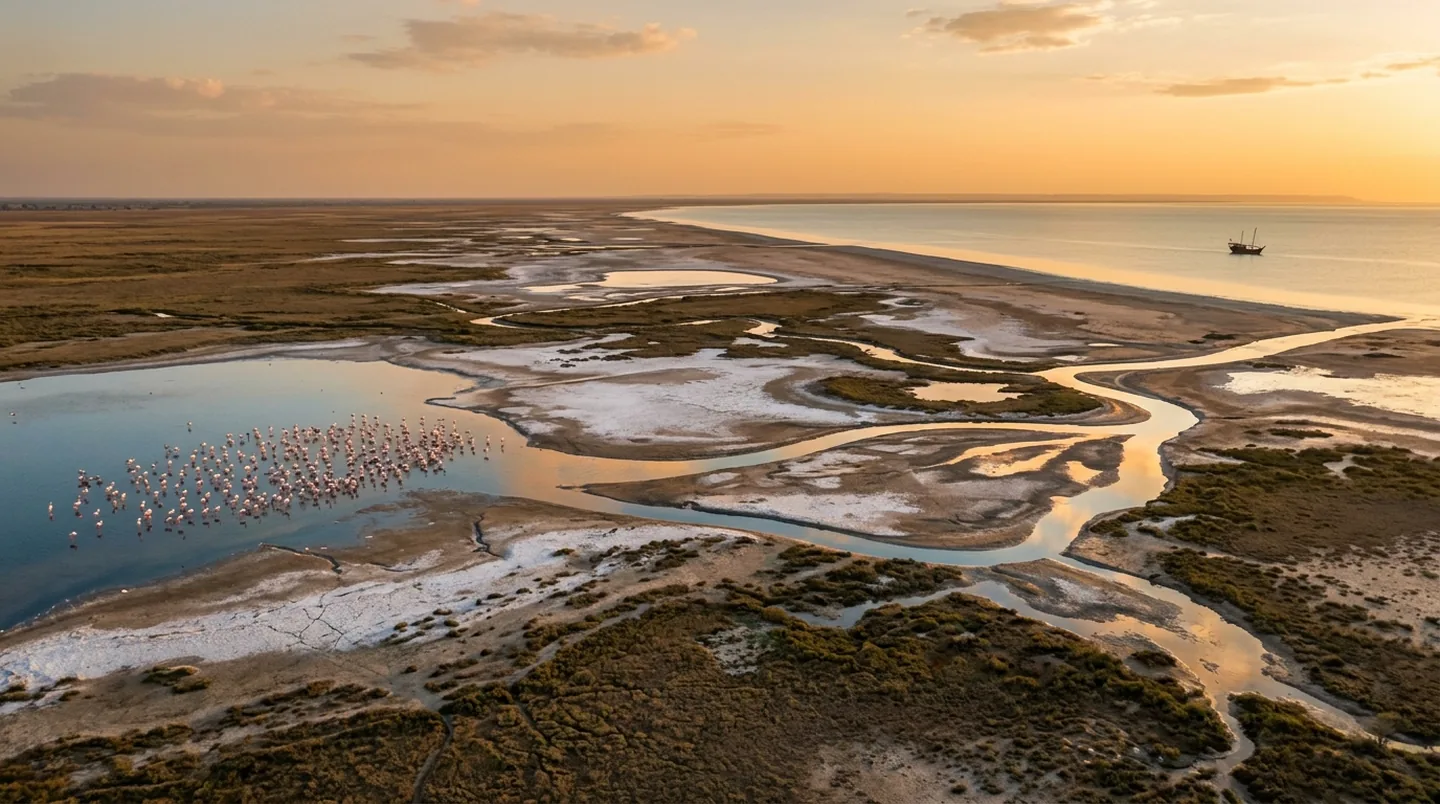
Lothal is a Harappan port town in the Bhal, the flat coastal plain that runs along the Gulf of Khambhat. It stands on the Bhogava river, a tributary of the Sabarmati, at the point where inland Gujarat's river network meets the Arabian Sea's trade routes. That geography is the whole story: the gulf has funnelled ships, goods and ideas between the sea and the hinterland for well over four thousand years, and Lothal sat at the hinge of it.
The site belongs to the Mature Harappan urban phase, conventionally dated c. 2600–1900 BCE. Within that arc, the excavation record places Lothal's flourishing as a port town around c. 2400 BCE, followed by a long decline from about c. 1900 BCE. In other words, the harbour had already lived and faded twice over before the medieval harbours of the gulf — and three millennia before the word "Dholera" carried anything more than a village name.
Discovery and excavation
Lothal was discovered in 1954 and excavated between 1955 and 1960 by the Archaeological Survey of India under S. R. Rao. Along with Dholavira in the Rann of Kutch, it became one of the two best-known Harappan sites in Gujarat — and the one that anchored the civilisation's maritime chapter.
What the excavators found was a settlement of roughly seven hectares with an acropolis and a lower town, brick architecture throughout, and a bead-making workshop that points to craft production at scale. The town plan is legible even now: a raised citadel on the higher ground, the working town below it, and the whole arrangement oriented toward the water.
The basin they called a dockyard
The feature that made Lothal famous is a large rectangular basin, approximately 218 metres long and 37 metres wide, built with brick walls and a lock-like arrangement at its outlet. The excavators read it as a tidal dockyard: a basin where ships could sit afloat at low tide, loaded and unloaded on a schedule set by the sea rather than the river.
If that reading holds, Lothal's basin is among the earliest dockyard structures identified anywhere in the world. And "if" is doing real work in that sentence. Later studies — including multi-sensor work on the Sabarmati–Nal corridor published on Harappa.com — have questioned and refined parts of the original interpretation. The honest position is the one this site takes everywhere: the basin is real, the brickwork is real, the dimensions are recorded, and the function attributed to it remains an interpretation under active scholarship. We report the interpretation and the scrutiny together.
UNESCO status, kept precise
In 2014, Lothal was added to India's UNESCO World Heritage Tentative List (entry 5918). The distinction matters and is routinely flattened in property marketing: a Tentative List entry means a state has nominated a site for possible future nomination to the World Heritage List. It is not a World Heritage inscription, and Lothal is not one. We track the status exactly as UNESCO publishes it — and upgrade the language only if UNESCO does.
The National Maritime Heritage Complex
The National Maritime Heritage Complex (NMHC) is the live development programme at Lothal — a large public heritage project under the Ministry of Ports, Shipping and Waterways. Per ministry reporting of 11 September 2026, Phase 1A stands at approximately 82% construction progress, with a revised completion target of 31 October 2026. Targets move; we track the movement rather than freeze a press-release number.
The complex matters for this pillar for a simple reason: it will concentrate serious museum infrastructure, conservation work and visitor attention at the site. How that interacts with the archaeology — what gets protected, what gets presented, and what remains uncertain — is exactly the kind of story this site follows with sources rather than enthusiasm.
Lothal and Dholera: connected, not conflated
The two sites share a region, a gulf and, in the widest sense, a story about this coast and its connection to the sea. What the sources do not establish is direct historical continuity — no reviewed evidence turns Lothal's Harappan harbour into a provenance for Dholera's industrial city. The connection is geographic and regional. We keep it that way, and this page stands next to Chapter 1, Ancient Dholera precisely so the deep history and the modern revival each keep their own record.
What this pillar grows into
This page opens the pillar; it does not close it. The planned lanes, each evidence-led and added when the source pack is ready:
- Archaeology and urban life — the excavation record, the town plan and daily life, tied to ASI and archaeological publications.
- Maritime network and trade — what Lothal traded, with whom, and how the gulf connected to the Indus world.
- NMHC status tracking — the heritage complex as a live, dated, verifiable programme in Ongoing Intelligence.
Until those lanes arrive, this page stays within what the reviewed record supports. That is the editorial promise, kept.